Monday, April 28, 2008

Kate Playground Hd Or Hq

How to mount Windows partitions on login

  • Following the launch of the new Ubuntu 8.04 Hardy Heron, I decided to do a clean install for health reasons. Since my introduction to the GNU / Linux with Ubuntu 6.10, I had only just updated versions. Obviously at the beginning you do not know a lot and sometimes he reaches beyond the mind. Therefore, fingerprints and debris being left for so long of abuse (ja). This time I decided that a fresh install would contribute to the maintenance of my system (note my obsessive traits).
  • After installation, you have to necessarily go back to "pimp" the Ubuntu to suit your needs. It's like furnishing and decorating the room you will live. So in many cases, one is again faced with some problems solved long ago, but now some options have changed places and others have provided.
  • So I'll post the tips below are probably known to the old user, but nevertheless may help the novice who just joins this fascinating scene.

    This time, I will refer to a couple of modifications to expedite the time it takes to enter the system. The first amendment

    aims to reduce the waiting time in the bootloader (GRUB

    1. )
    2. . The second change allows
    3. start a user account automatically
    , not having to type the username and password each time we enter the operating system.

    1. Speeding up the boot loader (GRUB

    )

    Bootloader (GRUB

    ) is that we can start one or another operating system installed on our machine. Typically, a menu appears where we go versions of the kernel (kernel ) we have installed Linux with versions of Windows. Editing the GRUB configuration file

    As involves changes alter the GRUB risky to change the configuration file (/ boot / grub / menu.lst) should log in with root privileges (su). For this, open the dialog "Run Application" (Alt-F2) and type

    gksu gedit / boot / grub / menu.lst

    We ask the root password. After joining we will open a text editor window with the file. Now we can proceed with the issue.

    reduce the waiting time You'll notice a line that goes 10 timeout (line 19 aprox.). The number 10 indicates the number of seconds counts down the menu. Typically 10. We will reduce to a reasonable number so as not to wait. Personally I leave in 3 seconds, if you ever wanted to start with another kernel version (kernel ) or with the Windows partition (yes, I admit that I have a Windows partition, but I have not used for months). Hide the menu

    Find the line where he says # hiddenmenu

    (line 23 aprox.) And uncomment the line, removing the pad or sign cat (#). By doing this, when you boot your machine and not the menu appear but only the countdown. If you want to access the menu you will be prompted to press any key, otherwise remain hidden.

    After making the changes you deem appropriate, save your changes. Remember that this configuration file is essential to start the operating system, so any mistake can cost you a headache. Make a backup of the file or keep your Ubuntu disk handy in case of emergency. 2. User login automatically

    If we only have one user in our system, can save valuable time skip the input window in which we are asked to enter the username and password.

    For this, we
    menu System> Adminisitración>
    input window. We will open a window where we can modify some aspects of it. For our purposes, we went to the "Security" tab and check the box that says "Enable automatic login." Drop-down list, select the user you want to start our system. Then close the window and the next time you start the system we can enjoy our changes.

    Sunday, April 27, 2008

    New Tech Of Mesterbation Male

    How to remove the emblem (arrow) of the links on the desktop in Hardy

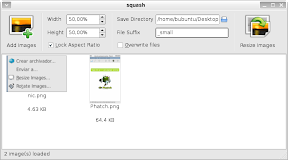
    In search of a simple tool to edit images in bulk, I found three very distinct from one another. At first my intention was to resize multiple images to be sent by mail (because GIMP do it one by one, had been an ordeal), however, it is understandable that one day you need another type of bulk (batch

    ) such as rotating or adding a watermark, and so on. Squash

    The simplest and lightest of the three. Their only function is to resize images, indicated by a percentage (not pixels). Comes in a package. Deb which can be downloaded from the website

    . However, there will automatically be added to the Applications menu so we have to do it manually or by running it from "Run Application" (Alt-F2) and typing

    squash

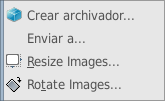
    nautilus-image-converter

    More than one application is a script that adds to the Nautilus context menu (right click on the file (s)). Includes two options: "Resize Images ..." and "Rotate ...", Images are for resizing and rotating, respectively. can install from Synaptic (System> Administration> Synaptic Package Manager) package

    looking nautilus-image-converter . Because it uses as ImageMagick dependency, installation will take us approximately 3.3 MB.

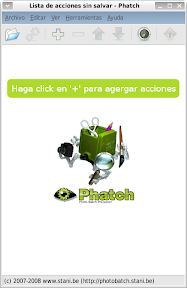
    Phatch (Photo Batch Processor)

    definitely the most complete of the three. Among its features includes: resize, rotate, round the edges, add watermark, add a shadow and include a text. On the other hand, images can be saved in many image formats PostScript and PDF.

    Their form of use is not as obvious as the previous tools, but it is not difficult to learn, is a set of rules to be applied together at the end of the process. In this way, we can combine the different options described, without having to start the whole process every time. This application weighs about 3 MB and is python dependencies

    ,

    vxpython

    These three utilities differ primarily in the number of options they have. So choosing should not be too difficult, depending on your needs. Below is a comparison chart:
    Squash

    nautilus-image-converter

    Phatch

    Installation Package. Deb Synaptic Package . Deb

    Resize

    Rotate Other Round edges, a watermark, add text, add shadows, change format Alt Access -F2> "squash" context menu (right click) Applications> Graphics In a concise article Be Linux my friend mentioned the 3 Kflickr . In this post I want to present the tool that I use, FlickrUploadr official recommendation is to use Flickr * ), Making it the most efficient option. It also integrates well with the Ubuntu desktop (GNOME) to be written in Python and GTK. Its operation is typical drag and drop.

    Saturday, April 26, 2008

    How To Make A Cake Helmet

    Setting the desktop

    of more frequent applications to upload images to Flickr, namely jUploadr , Dessert and
    (yes, I know it's not a very original name). While jUploadr, large (dis) advantage is that it is written in Java. And personally I do not think it is justified to start a Java virtual environment to run an application that simple. (In fact, I find it a waste of resources). Unlike other tools for loading, FlickrUploadr weighs only 35 Kb (
    How to install? Since 's website and download the latest version. (Currently 1.0 ). Then perform the following steps: Unzip

    file folder. Tar.gz (eg FlickrUploadr-1.0.0) Open a terminal window and enter the just unzip folder. For example, if the personal folder unpack wrote: FlickrUploadr-1.0.0 $ cd At this point we see that we have the package python-dev previously installed on your machine. For this we went into System> Administration> Synaptic Package Manager and look for it. Check that is green. Otherwise, install it (right click> make install> Apply) We return to the terminal and type: python setup.py install

    Follow the installation steps

    Settings Once downloaded

    FlickrUploadr, can be run from a terminal or from "Run Application" (Alt-F2), typing

    Uploadr (eye with the first case.) The first time we open the program asked to authorize us in our Flickr account, for which we enter the service and give the necessary permissions.

    To access this utility so simple, you can create a launcher (shortcut) in the Applications menu. For this, we make a right click and go to Edit menu. We will open an editing window of the Main Menu: In the list on the right choose the group where we add our pitcher (for example, can be "Internet" or "Graphs").

      We click on "New Item" and we will bring up the "Create Launcher"
    1. Fill with the information you requested. Name: FlickrUploadr. Command: Uploadr.
    2. The program does not come with an icon, but we can use this image for the shooter. OK
    3. And we can enjoy our FlickrUploadr:)
    4. Considerations

    program can not add descriptions of the images directly. Once uploaded the pictures, it opens a page where we can edit.

    can not select the album you want to upload the photo. This must be done by the Flickr Organizr.

    does not allow individual licenses (Copyright, Creative Commons) for each image. Use the default settings of the account.

    Ubuntu official tool is
    1. Dessert (Flickr Uploader) found in the application installer. (Which means better support and automatic updates.) F-Spot can also upload images to various services, including Flickr.
    2. In sum, FlickrUploadr is a lightweight and easily complemented well with the website features. However, unlike other tools mentioned, it has all the features imaginable. Ideal for users who do NOT have a pro account, or simple applications like (minimal)

    Milena Velba Et Nadine Jansen

    reducing waiting times to start Ubuntu

  • Good graphics, good music and fun gameplay
  • Some time ago I knew of its existence but I was encouraged to install (for the classes, time, etc.). But now I'm on vacation (and a long time since I updated this blog) I thought why not? And I was pleasantly surprised to confirm that Secret

    Maryo Chronicles is a game very well done and quite funny.

    Probably because I played video games in the early nineties, I got used to playing the classic 2-D platform: game with few actions (running, jumping and some other power) and relatively predictable. The 3-D games never impressed me enough (with the exception of the very old Wolfenstein 3-D, Quake, Heretic ... but that's another story.) Therefore, I am pleased that these projects are still there to rescue the old modes of play.

    oquéi http://ubuntu.org.ua/ getdeb / (Note: GetDeb also provides updates on other programs in Ubuntu, such as GIMP, Pidgin, and others. Generally, these tend to be newer versions than those provided by Canonical, but not being the official involve some degree of risk of incompatibilities. Update the program is not mandatory but must clear the boxes in the process)

    And the music?

    SMC has an interesting soundtrack that is NOT included by default in the game. To install, you must download a new package. Deb (approximately 30 MB) from the downloads page the SMC website. As simple as downloading and installing.

    Problems with the joystick?

    When I first installed the game I had some problems with my USB joystick. The game recognized the buttons, but not the directional axes (D-Pad). Searching the net I discovered that it was a recurring problem among users. Although concrete solutions are rarely found. Finally solved the problem, but I realized that the effectiveness of the methods will depend on each machine. Here I provide some information to take into account if they have the same origin:

    The problem seems to affect users of GNOME and not KDE. So if you have Kubuntu, there should be no problem.

    The problem seems to affect people who have installed the package jscallibrator

    or the "Joystick Calibrator" on the Ubuntu application installer. To resolve this issue, uninstall this package and

    delete the file ~ /.

    joystick (hidden file in your home folder). Then restart Ubuntu.

    If the above does not work, you can create an autorun file to load settings the joystick to start Ubuntu. More information on the blog A

    bioinformatiquillo I ran the second option. I uninstalled the "Joystick Calibrator" which had installed some time ago, I deleted the config file and voila!

    Indeed, I strongly recommend testing this game with joystick. Given the sensitivity of the movements (and the risk of RSI ) is better than using the keyboard.

    Wednesday, April 16, 2008

    Mechanism Typhoid Fever Causes Disease

    Lesson # 22: Your attention please


    Type: Attitude
    Scientific name: Atentionem captator
    Common name:
    Centerpiece
    Known by many names the length and breadth of the planet-vase, centerpiece, dauber and many others, this attitude is a fixed number scare when those around him, and is basically calling care disproportionately.

    The first step is attract attention. Speak very highly-it takes several decibels above the average, so if the environment is noisy should endeavor-is a good start. If you do not have a partner who scream, just pretend a conversation with your mobile phone, with a high voice, as if no one else was present. The line at the bank is the ideal place to start in practice.

    transfer to a second stage is urgently needed because not attract enough attention . Once captured, we must seize it. And this is where to bring out the best of their repertoire: the stale jokes that only you laugh, hopefully loudly, and family history that anyone interested, all while maintaining the high-decibel performed at the first step, are just what you need to become a being detestable.

    If you want to go further, there is still a step: stop stories of others, take any point of the topic, any word even to engage with his story. The idea is that nobody can put on you as the center of attention.