Saturday, December 20, 2008

How To Drink Captain Morgan

Ubuntu Install OpenOffice.org 3 in Intrepid Ibex from the repositories (with Start Center)

Some users are surprised that Ubuntu does not have native support for compressing or extracting files in Crear Lanzador (awn-manager) 7z format, which is being an open format, high power compression. For

. No need to install additional applications.

Open Synaptic. Menu System> Administration> Synaptic Package Manager

package p7zip We

  1. We set to install and apply the changes.
  2. Now our Archive Manager (File Roller) automatically recognize files with 7z to decompress.
  3. addition to those wondering how to compress files in Ubuntu 7z, good news because the option is automatically added to the dialog "Create archive ...», accessible from the context menu (right click).

Source:

Tombuntu

Wednesday, September 3, 2008

Veins Of America Complaints From Patients

Lesson # 25: Here I come

Type: Attitude
Scientific name: Superiorem complexus
Common name:

arrogant attitude quintessential unbearable, arrogance is one of the most efficient ways to ensure not only the necessary square foot of personal space, but also the airspace that projects the same, otherwise very necessary considering that the arrogant is above the level of others. If you happen to be in the water, sea, beach or pool serve equally-even equivalent to ensure a mile territorial sea.

all starts with an arrogant attitude, looking at least to those who will cross ahead and considering simple constraints irrelevant, or at least accident-in his own existence, indeed essential to make the world go round. This attitude should be clearly denoted in body position, walking, how to look at others and how to address them, everything must be done from above . Once

appropriate to this physical layout, there is much of the way advanced. Now is the time to invoke the power-real or fictitious, or that of a near-and abuse it to humiliate anyone who dares cross his path. If the sentence addressed to her interlocutor uses big words, technical and / or other languages \u200b\u200b(see lesson # 9 ), demonstrated superiority certainly greater .

A final step -wear with caution, because of its high impact, is in support of its superiority in the past glories (see lesson # 8 ) and high economic power (see lesson # 3 ), combination really that safe explosive scare who is still close.

Jenna Jameson The Masure

Lesson # 24: Why do not you shut


Type: Review
Scientific name: philtrum absentiae
Common name: Unfiltered

Few attitudes cause more animosity in those around us, and therefore so few actually provide us our square meter shoot-like comments unfiltered one.

A first requirement is that such comments refer to anyone nearby to those who listen. In this way, can they bother. Best-and more effective, is that the comments refer precisely to these, so feel directly attacked.

phrases relating to clothing, hair, smell and generally any issue related to those mentioned are highly efficient. Comment out loud (see lesson # 22 ) the "awful shirt" or "disgusting perfume" of someone this is an excellent starting point .

If you want to go further in this field, must have additional information on their partners. Complicated medical conditions, family and work are very useful when to demonstrate the absence of filters. Wonder aloud "overcome it your wife?" A recently cheated, or launch a friendly "How is the prostate?" From one side to another in a crowded room, are phrases that will let you clear accurate fully , and for a while, her precious square foot.

Sunday, August 3, 2008

Diagram On Body Temperature

Adding support for 7-Zip

The screenlets are good way to increase productivity and aesthetics of your desktop. Furthermore, since version 0.1, supports both issues Screenlets SuperKaramba as Google Gadgets . The current version in Ubuntu repositories is 0.0.12. Here are the steps to install from the repositories this latest version (by far the best, according to developers

Step 1: Remove any previous version of Screenlets Open Synaptic. Menu System> Administration> Synaptic Package Manager Search

screenlets package

  1. marked for deletion. Click right> Mark for Complete Removal
  2. Apply changes Close Synaptic
  3. Step 2: Add the repositories
  4. now add the repositories of
  5. Julien Lavergne PPA (gilir)
  6. , who holds the packages for the latest Screenlets.

Open the properties of "Origins of Software." Menu System> Administration> Software Sources.

Go to the tab "Third-party software."

Add the following entries. Click the "Add ..." and copy (separately) the following entries:
  1. http://ppa.launchpad.net/gilir/ubuntu hardy main deb-src deb hardy main
  2. http://ppa.launchpad.net/gilir/ubuntu

  3. Close the window "Software Sources" . Install Screenlets
     
    Once you have added the repositories, we are able to install the new version of Screenlets.
  4. Open Synaptic. Menu System> Administration> Synaptic Package Manager Search

screenlets package

  1. Brand to install
  2. Apply changes Accept the warning Buscar paquete
  3. Close Synaptic
  4. Screenlets Now you can enjoy from the menu by clicking Applications> Accessories> Screenlets Advertencia

Friday, August 1, 2008

Is It Possible To Faint With Your Eyes Open

Installing Ubuntu Screenlets 0.1.2 in Hardy from

Screenlets Manager
A blog reader asked me how to use photos drawn as icons on the desktop, as shown in the screenshot. Mi escritorio (29 jun 2008) The truth is that these photos are not icons but turned
screenlets (specifically one called Frame

). But since I do not want to disappoint my readers, then explain how to have pictures drawn as icons.

Step 1: Create our photo In this first step we will edit a picture you want to convert an icon to fulfill the necessary characteristics. Use the GIMP image editor installed by default in Ubuntu. (By the way, if you have it installed, I suggest using Inkscape and be made more intuitive)

opened our image with The GIMP.

If the image is very large, scale to a smaller size. Menu Image> Scale Image ... I think 200 x 150 pixels is an appropriate size, although this depends on each person.

  1. We rotate the image. Menu Layer> Transform> Arbitrary Rotation ... In the dialog box, type the number of degrees in which you want to rotate the figure. Usually a number between -15 and +15 is fine.
  2. adjusted the canvas layer. After rotating the layer, some parts of the image have been off limits. To fix this go to menu Image> Fit Canvas to Layers. It should be something like this:
  3. Save the image as PNG
  4. . It is important that the image is recorded in a format that allows transparency. PNG format is appropriate because
  5. accept as many colors as JPEG and GIF transparencies. Step 2: Create a desktop icon
  6. predisposed With our image and we are able to create our desktop launcher.
create a new launcher. Right click on the desktop> Create Launcher ... Fill

data from our pitcher. Remember that you can make your icon

has no name visible. If you want to link to a folder, check this entry
  1. .
  2. changed the icon. We click on the button that shows an icon of our pitcher. We will open a dialog box with icons available. We press the button Browse ... to find the location of our icon, or enter it in the top bar (eg ~ / icon.png). We accept.
  3. accepted to create the launcher. Check that all data are correct. enlarged the icon. By default, the icon size will be reduced. To enlarge give right click and select "Stretch icon". From one corner, drag to the size you deem appropriate.

Thursday, July 31, 2008

Fleetwood Travel Trailerowners Manual

repositories Rotated pictures as icons

The following method has been tested on Ubuntu 8.04 (Hardy Heron). To its proper functioning as a media player using MPlayer. Step 1: Install MPlayer Opens Ubuntu application installer. Applications> Add / Remove ... Search

MPlayer Movie Player. Select and apply the changes.

  1. Step 2: Download and install extra codecs
Go to the download page

Select MPlayer codec package for your system. Probably Linux x86, but will depend on your processor architecture. (As far as possible via Torrent download them not to saturate the servers)
  1. Once downloaded, open the essential-
  2. xxx.
  3. tar.bz2 Extract the content folder to the desktop (eg essential-20071007 )
  4. Rename the folder to codecs
  5. (right click> Rename ...) Opens a file browser with root privileges: In "Run Application" (Alt-F2) type gksu nautilus
  6. . And put the root password. Move the extracted folder on your desktop (
  7. codecs) to / usr / lib . Nautilus
  8. Navigate to / usr / lib
  9. and drag the folder to codecs here. Step 3: Install libstdc + +5 Open Synaptic. Menu System> Administration> Synaptic Package Manager Search

package libstdc + +5

  1. Brand and install.
  2. (Apparently this package is necessary for the proper functioning of the MPlayer codecs.)
Step 4: Configure MPlayer MPlayer Open.

Open the Preferences window. Right click> Preferences

In the tab "Video" select the driver
    X11/Xv
  1. In the tab "Codecs & demuxers." Change the following options:
  2. Video codec family: RealVideo decoder
  3. Audio codec family:
  4. FFmpeg / libavcodec audio decoders

  5. Close the player for the changes to take effect the next time you open
  6. Paso 5: Setting MPlayer as default player for files. rmvb
Properties window opens. Right-click a file. Rmvb and select Properties. In the tab "Open with" MPlayer Movie Player selects the list of applications

Close the window to apply
  1. changes
  2. Now you can play your files. rmvb in Ubuntu!
  3. Sources: Simple
  4. Help the option "No sound"

Close the Preferences window.

In this window you can also control other audio responses to regular interactions with the GUI

.

Saturday, July 19, 2008

Purdue Gay Cruise Spots

I play. rmvb in Hardy

  • capture my desktop icons without name
  • Perhaps you've ever wondered how to get the names to the icons on the desktop, so that it appeared only the image. (Indeed, what sense does that say Bin Trash just see if we realize what it is?) To stop the icons without name do the following: Open the

    'Character Map' on the Applications menu> Accessories In the column 'script' (left) select

    . We will select the character U +00 A0 NO-BREAK SPACE, which is just before open-sign-of-exclamation ()

    selected the or icon (s) on the desktop whose name we want to delete. Rename the icon

    (F2 or right click> Rename ...) and paste the character you just copy (Ctrl-V)

    1. In this way, the icon left with a blank name, which will be invisible. You can do this with all the icons you want. It is noteworthy that serves not rename the icon with a normal blank (spacebar). This character (U +0020 SPACE) is ignored by the system and returns the icon to its original name. There are other
    2. desktop configurations that might interest you.

    Monday, July 7, 2008

    Kitchen Islands Blue Prints

    How mute Login

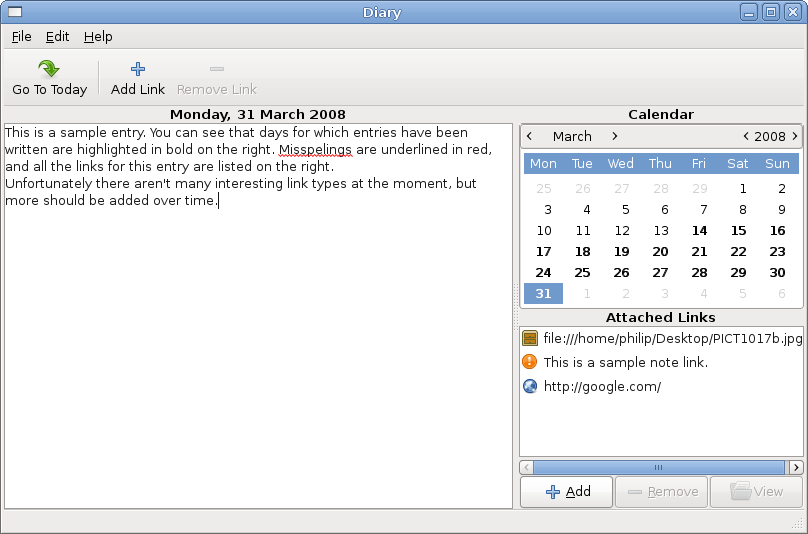
  • some time ago had considered the possibility of having a notebook to jot down some ideas, thoughts or important things I did not want to forget. I know that in the past I had good ideas but do not have written anywhere and I've forgotten or lost forever. The problem is that writing on paper is not properly secured (you can lose) and, above all, time-consuming. (At least I took longer to write with pen and paper to keyboard).
  • was so Diary discovery excited me enough. Diary is a small and lightweight application that serves well for the purposes of daily life personal blog (not to be confused with blogging). Among other features, Diary features: spell checking, data encryption, searching and printing of tickets and the use of links (to websites and files.)
  • Due to its simplicity, was the program that convinced me. Other alternatives that may interest you are: eJourn

    ,

    GnoTime

    , Monodiary ,

    myDiary or Xournal . Add the repositories

    The easiest way to install in Hardy's Diary through repositories

    of its author. For this we must add the sources to our list of repositories.

    Open "Software Sources" in System> Administration. Go to the tab "Third-Party Software" and add the following lines to the "Add ..." (separately): http://ppa.launchpad.net/drbob/ubuntu deb hardy main deb-src http://ppa.launchpad.net/drbob/ubuntu hardy main Close the window

    Installation After adding the repositories, proceed to install the software via Synaptic. Open the

    "Synaptic Package Manager" in System> Administration

    We
    1. diary package
    2.   We make and install  
    3. You can find the program in the Applications> Accessories.
    4. Quick Links: Project website

    is disabled. But you may wonder, why remove the panels? This could be useful if you install a launcher bar or dock

    style
      Avant Window Navigator, for example.
    1. Well, googling around I found a forum
    2. where detailed several ways to do it. One was closing gnome-panel and avoiding open each time you log on (System> Preferences> Sessions). However, in doing so, it also removed the command to "Run Application" (Alt-F2), which often has been useful.
    3. So how more advisable to remove the last panel in GNOME seems to be through a tweak
    4. who hides permanently. To do this, do the following:

    Runs GNOME Configuration Editor. Open "Run Application" (Alt-F2) and type gconf-editor

    Go to the key / apps / panel / toplevels and select the panel stated (eg panel_0

    ). Edit the following parameters:

    auto_hide

    auto_hide_size

    1

    1. expand
    2. hide_delay unhide_delay x 10000 And goodbye GNOME Do is a very versatile application that can do many things with just a couple of keys. It has been listed as an application launcher, but it is clearly more than that. Allows exploration and administration Basic file (open, copy, move), opening Internet addresses and a number of common tasks by as many plugins that we can install (bookmarks, email, contacts, music, etc.). GNOME Do is not restricted to this application desktop environment, but obviously his aesthetic is complemented best with it. It works in KDE and "other common environments (although given the vagueness of the information I do not know if it includes XFCE, Enlightment, or other). What is recommended is to have windows activated composition (composite). It is not essential but highly recommended. So if you do not have this option yet, there are three different options from which you can choose (depending on the characteristics of your machine):
      1
      10000
      10000 and
      panel!

      Sunday, June 29, 2008

      Has Anyone Used Ovulation Kit

      How to remove the name of the icons on the desktop

      is emerging as a useful and powerful if we can integrate our personal repertoire of interactions with the operating system. Requirements
      Enable Metacity composition Open the 'Configuration Editor' of GNOME. Press Alt-F2 to open "Run Application" and type gconf-editor
      Active
    3. composition windows. Get a Clue
    / apps / metacity / general / compositing_manager and activate. Toggle Compiz

    Opens the "Appearance." Menu System> Preferences> Appearance Active visual effects. Go to the tab "Visual Effects" and select the option that best suits your needs (Normal or Extra). Both work for these purposes.

    Cairo Composite Manager

    ended

    This manager has the grace not require 3D acceleration, so that may be suitable for users with a video card not as powerful. Learn how to install Ubuntuland

    Installation

    The easiest way to install it through the Ubuntu application installer. It is the latest version but is the most stable (and better support). [For a revsión of the new version 0.5 "The Fighting", check out the blog
    1. the author]. So let the Applications menu and select "Add / Remove ...». Seek by GNOME Do, marked and installed. (If you search for "do quick" is more expeditious)
    2. For the program to automatically load each time we started our session in Ubuntu should include it in the startup programs:
    opened the window of "Sessions" . Menu System> Preferences> Sessions
    GNOME Do We add to the list of startup programs. Click the "Add" and open the dialog "Create Launcher." Complete information: GNOME Do (Name), gnome-do

    (Order)
    1. Accepts
    2. changes.
    Usage

    The first time you open the program from Applications> Accessories> GNOME Do. Once executed, you invoke using the key combination: Super + Spacebar. (Super is the key between Ctrl and Alt is also known as the Windows key, yuck!). You will see a box like this:

    Now write a word, such as "personal." The program will show in the first square to create the item you're looking for, such as "Personal Folder". In the second rectangle you get the command to run the program, in which case Run (Run). When press enter, the program will open a Nautilus window in your personal folder.

    That is the basics of the program. Now let's do something a bit more complex. Suppose I want to move an image (Hitos.jpg) from the desktop to my personal folder:

    invoke GNOME Do Super + Spacebar
    1. Click "hit" and the program recognizes the file "Hitos.jpg" and I suggested Open action (open)
    2. Because I want to open but not moving, Press TAB to move to the square of the right (action to perform). write "mo" and the program suggests to me the action "Move to" (move a. ..) so that I get a third square (target)
    3. Press Tab again to move to the third square and click "jav" to show me my personal folder (whose name is "javier") I press Enter.

    The program usually recognize the actions we want to do, but when it does not, we can still press the directional keys (up or down) to display a menu of options available. Other configurations

    By default, GNOME Do indexes the Main Menu items and your personal folder (not subfolders). To tell the program what directory index we should edit the configuration file

    ~ / .config / gnome-do / FileItemSource.config

    . The configuration format is FILE: sublevel. For example if we want to index a subfolder within Documents, we can add the line: / home / USERNAME / Documents: 1

      either:
    1. / home / USERNAME: 2
    2. The difference is that the first is restricted to a sub-level within documents, while the second includes two levels of subdirectories within the entire home folder (including Documents). In case you want to index all the sublevels within a directory can put
    3. -1
    4. To increase the chances of GNOME Do has arranged a series of plugins
    5. with different functions that can check on the website.
    Official Website.

    What Kind Ofcamera Did Bella Get In New Moon

    Diary: a diary in Ubuntu

    Here's a deathmatch between Zero, Pikachu, Sonic

     Bub and some time ago there was talk of this game on blogs. Typically described it as a multiplayer game (up to 4 players) in which the goal is "to crush Mario." I installed it to try and I must say that Super Mario War is much more than that. When I first started playing I thought it was a sort of Super Smash   Bros. 
    mixed with the classic Mario Bros. arcade

    of. But exploring the many options that brings I realized that he could still become more interesting.

     Say, for starters, you may compete in up to 17 different minigames. It also has a host of characters to choose from, including not just Mario and his friends, but also characters from other games and even on other consoles. On the other hand, there are hundreds of stages to choose from.   definitely a game that deserves to be in the collection, especially if we want to beat us to a duel against a friend or the computer. How 

    install (The following method is not the most elegant but it is suitable for beginners)

    Go to

    downloads section of the website and download the binaries of the latest version (currently 1.7 April Fools Edition.) Open the tarball
    usr (you can drag and drop it onto the Desktop)
    Open a Terminal window (Applications> Accessories> Terminal)

    We go to the folder where unpack. For example, if the folder extracted usr on the desktop, you type cd Desktop (in Hardy). Copy the folder

    usr

    freshly drawn to our team. For this we need root privileges.

    write sudo cp-r / usr / * / usr /

    Once copied, run the game with the command

    SMW
    1. Note: Some people may receive an error message because there is no package
    2. libpng3
    3. . This package can be installed from Synaptic (System> Administration> Manager Synaptic package) or from the Terminal with the command sudo aptitude install libpng3
    4. Adding a launcher to the Games menu
    5. To run the game we can open the "Run Application" (Alt-F2) and type
    6. SMW
    7. . But to make it more expeditious to the Games menu can include: Let System> Preferences> Main Menu. It opens an editing window of the Main Menu
    8. At the left side menu select Games.
    9. We click on the button "New Item" and opens a dialog box to create a new launcher We fill all fields. In "Command" wrote
    10. SMW. (For the icon can use this vector
    11. I did) accept the changes

    And enjoy!

    Friday, June 27, 2008

    Equities Derivatives Interview

    Removing panels

    You have probably noticed that while the Ubuntu file manager (File Roller) recognizes the. Rar and zip files, you can not open them.

    When we look at the Ubuntu application installer, the only solution we found is RAR, a shareware program

    having 40 days of evaluation.
    1. suppose that this solution is not liked by many Ubunteros. (Neither is to send us compressed files in RAR). But hey, is not the end of the world because there is a package that allows us to open (not compress) the above default file manager of Ubuntu.
    2. To install it, open Synaptic (System> Administration> Synaptic Package Manager) and look for the package unrar
    3. . Mark it and install. By the way, will probably find a package called unrar-free . Here the word means
    4. free
    open and free not . So do not be confused with shareware

    mentioned above. The difference is that open source (free

    So if you're the advocates of open source Orthodox Settle free version . (Even if that were the case, probably never would have accepted a RAR file ...)

    Wednesday, June 18, 2008

    Difference Between Yellow Bars And Green Bars

    GNOME GNOME Do: Setup and

    Continuing with the modifications recently installed Ubuntu 8.04 ... A recurring theme when installing Ubuntu is access to partitions of Windows XP or Vista (NTFS

    ). While the system automatically detects and creates links to them from the Places menu, not automatically mounted at boot. But does so while trying to access them.

    This mode can be a bit annoying if you have the habit of using links to the folders on the Windows partition on your desktop, because it may appear as broken links and inactive. The traditional method to automatically mount the folders on other partitions to start Ubuntu is editing the configuration file / etc / fstab . However, given the moderate complexity of the options that must be handled, this method may not be accessible to the beginner. For this reason, we can use a graphical utility that provides us with quite the problem, called "NTFS Configuration Tool." You can install directly from the Ubuntu application installer (menu Applications> Add / Delete ...). Make sure the Show drop-down menu, is selected "All available applications" Once installed, this small application will appear in the Applications> System Tools. When we open a window with NTFS partitions detected where we can make those who want to configure. This utility will automatically edit

    configuration file / etc / fstab for partitions mount automatically each time you log into Ubuntu.

    Friday, June 13, 2008

    Multiplayer Trivial Pursuit Online

    Super Mario War: How to install

    Gutsy When he had several links on the desktop to the folders you used recursively. And I remembered that they had the emblem of symbolic links (diagonal arrow). But now I installed Hardy Heron, I tried to copy these links on my backup drive and I got a sad surprise: no longer worked! (Obviously check that pointed toward correct and all). So I searched on Google but only found people who had the same question. The only answer I found was to delete the symlink icon in the system (eg
    / usr / share / icons / Tangerine / scalable / emblems / emblem-symbolic-link.svg

    ). Of course, I did not consider this solution as appropriate. So, I stopped to think for a moment how to get out of this problem.

    Well, I remembered the technique of reframing strategic systemic therapists, when you have a problem, probably because it is conceptualized as a problem. If you change the way we think, the problem disappears. And I said, it really is a symbolic link I need? (I say at once that you can not make hard links to folders). In fact, the title of this post has no solution. But I figured that people would look that way ... (Let alone those in search of "shortcut" instead of link or "arrow" instead of emblem).

    But enough of such talk and let the solution:

    Right-click somewhere on the desktop and select "Create Launcher ..." Fill in the blanks

    "Name" and "Comment" with the necessary information . Check that 'type' appears Implementation.

    Section "Commando" writes: nautilus - no-desktop \u0026lt;location>

    . (Example: nautilus - no-desktop / media / windows / MyFolder )

    Change the icon you more comfortable (eg / usr / share / icons / Human / scalable / places / folder.svg )

    And presto! The solution was to call for Nautilus and pass the location of the folder as parameter. Of course, there are three caveats:

    If the folder you want to link it contains spaces, you must put a '\\' (Backslash backslash

    ) before each space. For example:

    / media / windows / My \\ Documents

    1. If you use another file manager (Thunar or PCMan as File Manager) will have to make any changes, replacing the command nautilus
    2. by thunar
    3. or pcmanfm as appropriate Not being blogs, Desktop launchers not appear as folders in the traditional dialogs (file open or save). So for better access will have to manually add folders to the list of sites, through the Bookmarks menu of Nautilus.