 The problem is that writing on paper is not properly secured (you can lose) and, above all, time-consuming. (At least I took longer to write with pen and paper to keyboard).
 ,
GnoTime, Monodiary ,
myDiary,  NoteCase
or Xournal NoteCase 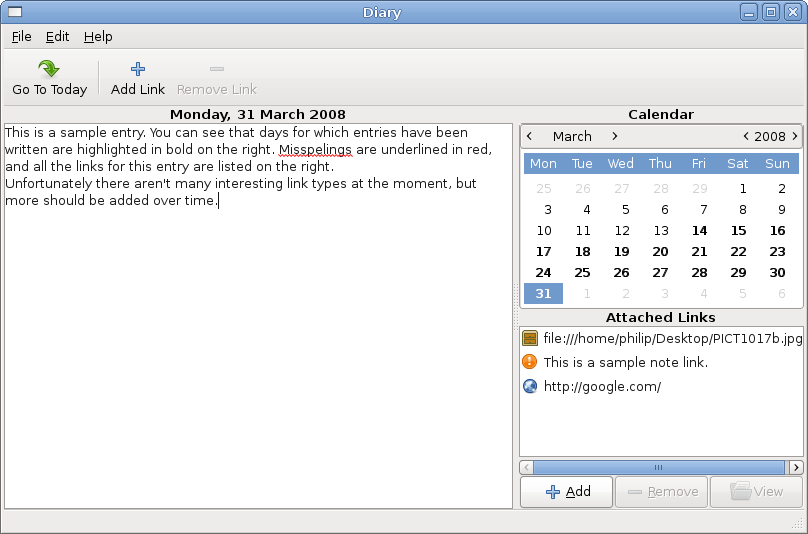 . Add the repositories
The easiest way to install in Hardy's Diary through repositories
of its author. For this we must add the sources to our list of repositories.
Open "Software Sources" in System> Administration. Go to the tab "Third-Party Software" and add the following lines to the "Add ..." (separately): http://ppa.launchpad.net/drbob/ubuntu deb hardy main deb-src http://ppa.launchpad.net/drbob/ubuntu hardy main Close the window
Installation After adding the repositories, proceed to install the software via Synaptic. Open the
"Synaptic Package Manager" in System> Administration
We- diary package
-
We make and install You can find the program in the Applications> Accessories. - Quick Links: Project website
is disabled. But you may wonder, why remove the panels? This could be useful if you install a launcher bar or dock
style
- Avant Window Navigator, for example.
- Well, googling around I found a forum
- where detailed several ways to do it. One was closing gnome-panel and avoiding open each time you log on (System> Preferences> Sessions). However, in doing so, it also removed the command to "Run Application" (Alt-F2), which often has been useful. So how more advisable to remove the last panel in GNOME seems to be through a tweak
- who hides permanently. To do this, do the following:
Runs GNOME Configuration Editor. Open "Run Application" (Alt-F2) and type gconf-editor
Go to the key / apps / panel / toplevels and select the panel stated (eg panel_0
). Edit the following parameters:
1
- expand
-
hide_delay
1 
10000 10000 and 
10000 And goodbye panel!  Subscribe to: Post Comments (Atom)
0 comments:
Post a Comment